Bold Quill Publishing Releases Dean Jessop’s Recognized Before Recommended, a New Book on AI Search and Business Discovery
Sep 21, 2026
New 213-page business book introduces RBR — Recognized Before Recommended — and examines why companies can be easy to find by name yet remain unseen when customers search or ask AI for what they need.
Delaware, United States, September 21, 2026 -- Bold Quill Publishing has released Recognized Before Recommended: How Businesses Get Found, Understood, and Chosen When AI Gives the Answer, a new 213-page business book by entrepreneur, author and
IRefer Club founder Dean Jessop.
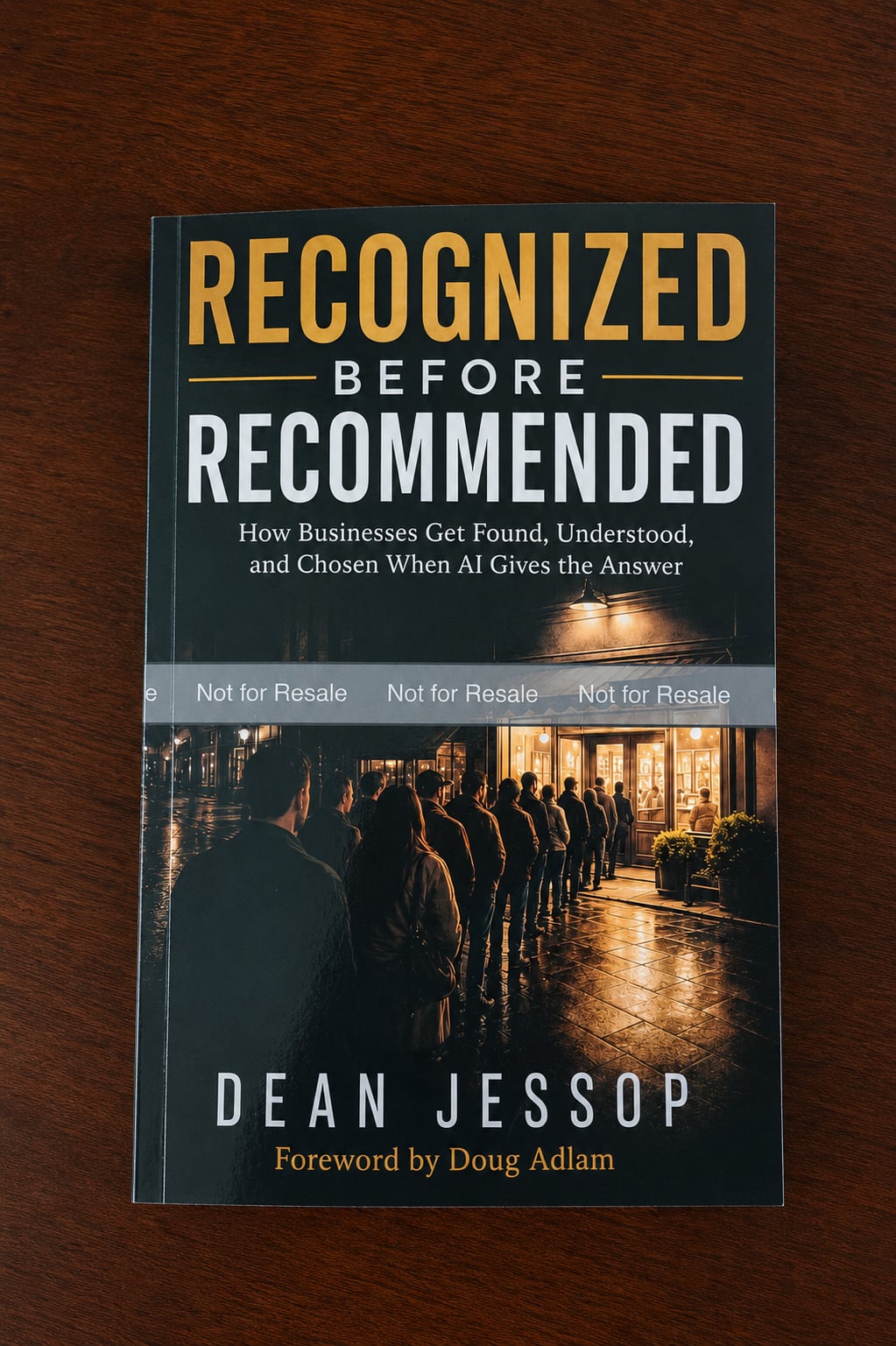
Featuring a foreword by Doug Adlam, Recognized Before Recommended examines a growing business visibility problem: a company can be easy to find when someone already knows its name and still be difficult to discover when a potential customer searches or asks AI for the product, service or solution that company provides.
The book introduces RBR — Recognized Before Recommended — as a practical framework for understanding that gap.
Jessop’s central premise is straightforward: before a business can reasonably be considered or recommended, it first needs to be recognized correctly and understood for what it actually does.
Being Found by Name Is Not the Same as Being Discovered
Businesses have traditionally tested their online visibility by searching for their company name.
Recognized Before Recommended argues that this answers only one kind of search.
A company may appear immediately when its exact name is entered into Google and still be absent when someone begins with a need rather than a brand.
A homeowner may need emergency furnace repair without knowing which HVAC company to contact.
A self-employed borrower may be looking for a mortgage professional experienced with non-traditional income.
A farmer may need someone who can repair agricultural equipment on-site without knowing which businesses provide mobile service.
In each case, the potential customer knows what is needed but may have no company name to search.
“The difference is between somebody looking for you and somebody looking for what you do,” said Jessop. “A business can be very easy to find by name and still be almost invisible to the customer who has never heard of it. Recognized Before Recommended is about understanding and closing that gap.”
What Recognized Before Recommended Means
Jessop’s RBR framework begins with recognition.
A business needs a clear public identity that connects its name with the products or services it provides, the customers it serves, the areas in which it operates and reliable ways to contact it.
Recognition is followed by understanding.
A broad category such as contractor, consultant, farm, retailer or mortgage agent may identify an industry without explaining the specific needs that business can address.
An emergency roofing contractor provides a different answer from a company focused on large commercial installations.
A mortgage professional experienced with self-employed applicants may be relevant to a different customer than one focused primarily on conventional lending.
A mobile agricultural mechanic may solve a problem that a repair shop requiring equipment to be transported cannot.
The book argues that these distinctions need to be clearly represented in the public information surrounding a business before that company has a meaningful opportunity to be understood for those needs.
Recommendation comes later.
RBR does not suggest that a business can force Google, ChatGPT, Gemini, Perplexity or another platform to recommend it. Those platforms determine their own results and recommendations.
Instead, the framework focuses on information businesses can influence: making their identity, products, services, expertise, locations and customer relevance clearer and more consistent.
Why AI-Assisted Search Changes the Visibility Question
Conversational and AI-assisted search allows people to describe problems in more detail than a traditional short search query.
A customer can explain a situation, specify requirements, ask for alternatives and continue with follow-up questions.
For businesses, that creates a different visibility question.
It is no longer only whether someone can find the company.
It is whether someone who has never heard of the company can discover it while asking for exactly what that business provides.
Jessop’s work on business discovery also extends through IRefer Club. A related business visibility resource, Why Is My Business Difficult to Find Online?, examines the same distinction between being found by company name and being discovered through a product, service, location or customer need.
That relationship between business identity, specific services and customer intent is central to Recognized Before Recommended.
A Practical Book for Business Owners
The book is written for business owners, entrepreneurs, marketers and advisers responsible for helping companies become easier to discover.
Rather than treating visibility only as a ranking problem, Recognized Before Recommended looks at the wider public record surrounding a business, including websites, business profiles, service descriptions, locations, reviews, outside references and contact information.
It also examines what happens after discovery.
Being recognized is of limited value if inaccurate information leads a potential customer to an old telephone number, incorrect location, broken booking page or unclear next step.
The objective behind RBR is not simply to produce more online content. It is to reduce ambiguity between a business and the products, services, specialties and customer needs that business can actually address.
About Dean Jessop
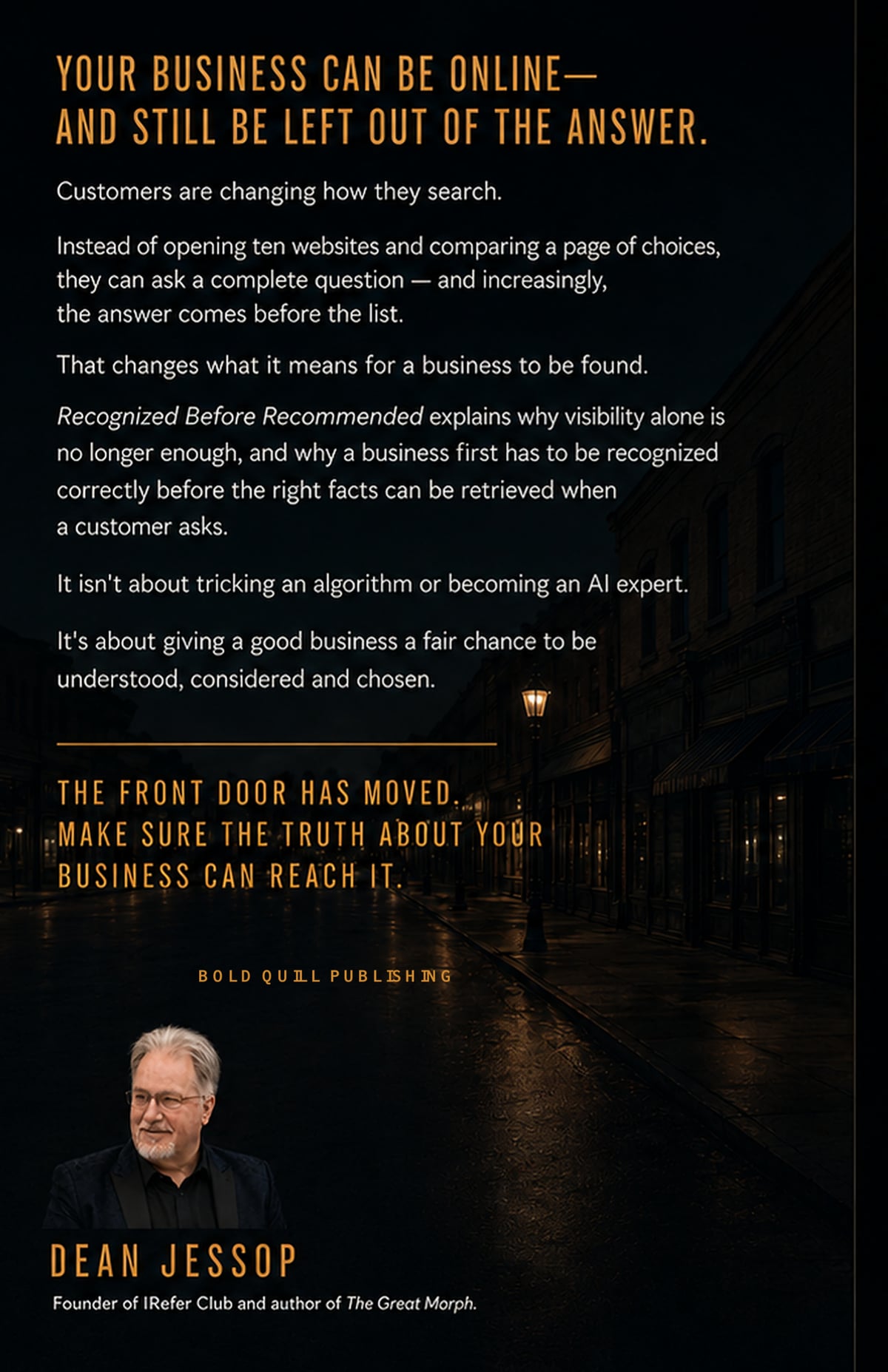
Dean Jessop is an entrepreneur, author and founder and CEO of IRefer Club, a worldwide business visibility platform.
His work focuses on how businesses are discovered as search expands beyond company-name queries into conversational and AI-assisted discovery.
Jessop is also the author of The Great Morph: Understanding the Shift from Being Found to Being Chosen.
About Recognized Before Recommended
Recognized Before Recommended: How Businesses Get Found, Understood, and Chosen When AI Gives the Answer is a 213-page business book written by Dean Jessop, with a foreword by Doug Adlam, and published by Bold Quill Publishing.
The book examines business discovery, AI-assisted search and the difference between being found by people who already know a business and being discovered by people searching for what that business provides.
The book is available through Amazon and additional information is available at RecognizedBeforeRecommended.com.
About Bold Quill Publishing
Bold Quill Publishing is an independent publisher based in Delaware, United States, publishing selected business, nonfiction, fiction and specialty titles.
Media, interview and review-copy inquiries regarding Recognized Before Recommended may be directed through Bold Quill Publishing.
Contact Info:
Name: Amanda Wall
Email: Send Email
Organization: Bold Quil Publishing
Website: https://www.recognizedbeforerecommended.com
Release ID: 89203816
If there are any problems, discrepancies, or queries related to the content presented in this press release, we kindly ask that you notify us immediately at [email protected] (it is important to note that this email is the authorized channel for such matters, sending multiple emails to multiple addresses does not necessarily help expedite your request). Our responsive team will be available round-the-clock to address your concerns within 8 hours and take necessary actions to rectify any identified issues or support you with press release takedowns. Ensuring accurate and trustworthy information is our unwavering commitment.
More News

First ladies step forward as Trump lays on rare honours for Xi
US first lady Melania Trump is set to lead key cultural diplomacy events during the coming official state visit by Chinese President Xi Jinping and his wife, Peng Liyuan, marking their first visit to the White House since 2015. According to an official itinerary released by the first lady’s office, the three-day visit, scheduled from September 23 to 25, will feature extensive ceremonial honours alongside dedicated cultural exchanges highlighting Sino-American relations. Melania will join US...

Fed's Kashkari: Inflation still too high in 'all aspects' of economy
Neel Kashkari, the president of the Federal Reserve’s Minneapolis branch, said Sunday that inflation is “still too high,” days after the central bank raised interest rates. “Even if we strip out energy, which is really volatile, and strip out food, they matter a lot, but in terms of where the economy is going, inflation is...

Barrasso says 'we need to do more' on affordability as midterms near
Senate Majority Whip John Barrasso (R-Wyo.) said Sunday that the GOP needs to “do more” to lower costs for Americans with the midterms roughly six weeks away. During an interview on NBC’s “Meet the Press,” Barrasso acknowledged that people “around the country are feeling the pain,” noting he has heard concerns from Wyoming ranchers and...

Trump and Xi Meet Amid an Uneasy U.S.-China Trade Truce
Beyond warm meetings between their leaders, the countries are engaging in tit-for-tat measures that call into question the stability of their arrangement.

Stronger won to test chip, display firms' Q3 profitability
The strengthening Korean won is emerging as a fresh earnings risk for chipmakers, display firms and other electronics companies that rely heavily on dollar-denominated transactions, prompting brokerages to cut earnings estimates for the third quarter. According to data from the Bank of Korea, Sunday, the Korean currency traded at 1,480 won against the dollar on July 16, before strengthening to 1,413 won on Aug. 17 and 1,382 won on Sept. 17. This represents a 6.6 percent narrowing in the dollar-won exchange rate over the two-month period. The change in the dollar-won exchange rate accelerated particularly from August, with the Korean currency gaining value to 1,336 won per dollar on Sept. 9. This prompted brokerages that had based their earnings forecasts at 1,450 won per dollar to begin cutting their estimates, causing the third-quarter earnings consensus for major companies such as Samsung Electronics and SK hynix to drop. According to market tracker FnGuide, brokerages’ consensus on Samsung Electronics’ third-quarter operating profit stood at 122.35 trillion won ($88.27 billion) o

Authentic Korean convenience meals attract foreigners
The global popularity of Korean food has reached a point where convenience store meal boxes, known as “dosirak,” have become part of a new market trend where signature Korean flavors and traditional recipes have become a hit with international visitors and popular in new markets. Min Jung-hwan, who plans and oversees dosirak production for GS25 at GS Retail’s Merchandise Headquarters, is seeing the shift firsthand. Rather than creating separate products for foreign customers, the retailer is increasingly offering the same dosirak that appeal to Korean consumers, reflecting growing interest in authentic Korean flavors. “We don’t make dosirak that are specially for foreigners because many of them like what Koreans enjoy. Even at GS25 stores in Vietnam and Mongolia, visitors are interested in authentic Korean-style dosirak. We try to meet such expectations so that they can feel they are inside a Korean convenience store,” Min said in an interview with The Korea Times. “To serve the rising number of foreigners coming to Korea, we are boosting a pipeline for those with banchan

Jeonbuk National University partners with defense companies on career-linked program
Jeonbuk National University has partnered with 15 defense companies and related organizations to offer a career-linked industry-academia cooperation program covering education, scholarships, field training and employment. The university said Friday that its Department of Advanced Defense Technology and Industry hosted a workshop titled “Customized Talent Development and Recruitment-Linked Cooperation Program for the Defense Industry” at Shilla Stay Jeonju on Thursday. The workshop was attended by university officials and representatives from defense companies and related organizations that signed a memorandum of understanding with the university in June. A university official noted that the workshop was organized to translate the memorandum of understanding on the cooperation program, signed June 26, into tangible outcomes in education and recruitment. Fifteen defense companies and related organizations are participating in the partnership. The participants included Hyundai Rotem, Korea Aerospace Industries, LIG Defense & Aerospace, HS Hyosung Advanced Materials, Danam Systems, DN Sol

Journalist-turned-political critic becomes new presidential spokesperson
Kim Sung-wan, a journalist-turned-political commentator, has been appointed as the new presidential spokesperson, the presidential office said Monday. Kim — a former reporter with Media Today and later a radio host and political analyst —officially assumed his duties as presidential spokesperson on Monday, according to Cheong Wa Dae. "I have often had my words passed along to others, but knowing that I am now speaking directly to the media makes me feel a heavy sense of responsibility … As President Lee Jae Myung has said, I will do my best to communicate more with the public with humility," Kim told reporters. The post has remained vacant since April, when former presidential spokesperson Rep. Jeon Eun-su stepped down to prepare for the June 3 local elections. Kim's appointment adds to the current two spokespersons — Kang Yu-jung and Ahn Gwi-ryeong.

Gov't, ruling party agree to lenient approach for minor violations in farmland survey
The government and the ruling Democratic Party of Korea (DPK) agreed Monday to take a lenient approach to minor violations identified in an ongoing national farmland survey while cracking down on clear acts of land speculation. The country launched the comprehensive nationwide survey earlier this year in an effort to determine actual ownership of farmland and prevent it from being used as a speculative asset. The move, however, has faced criticism from the main opposition People Power Party, which has argued the survey has caused anxiety among farmers and could infringe on their property rights. "If the purpose of speculation is clear, (we) will take corrective action under the law and principles," Agriculture Minister Song Mi-ryung said in a policy meeting with DPK officials. "For minor or routine violations identified in the field, (we) will provide guidance or take alternative measures, such as making improvements to the system." The minister said the government would focus on ways to restore the intended purpose of farmland rather than immediately taking action against violations. Rep.

Lee's approval rating rises for 1st time in 10 weeks to 34.8%: poll
President Lee Jae Myung's approval rating rose for the first time in 10 weeks last week, helped by his clarification of key political issues during a press conference, a pollster said Monday. In a poll conducted on 2,507 adults nationwide from last Monday to Friday, positive assessments of Lee's job performance rose by 1 percentage point from the previous week to 34.8 percent, while negative assessments rose 0.1 percentage point to 63.4 percent, Realmeter said. It marked the first time in 10 weeks that Lee's approval rating rose following a 48.9 percent rating on July 13. There was a gradual increase throughout the week from 32.9 percent Tuesday and 32.1 percent Wednesday to 35.3 percent Thursday and 37.2 percent Friday, the day he held the press conference. "At the start of the week, his approval rating continued to decline due to controversy over personnel vetting and the repercussion of the confirmation hearings," the pollster said. Lee's approval rating was beset by controversy surrounding the qualifications of Justice Minister nominee Kim Seung-won and Gender Equality Minister nomin

Samsung Electronics breaks ground on HVAC production line in Gwangju
Samsung Electronics held a groundbreaking ceremony for a heating, ventilation and air conditioning (HVAC) production line in the southwestern city of Gwangju on Monday. The company plans to invest approximately 240 billion won ($173 million) to build a 21,500-square-meter HVAC production line at its Gwangju operations site. The new production line, scheduled to begin operations in 2028, will manufacture HVAC products from FlaktGroup Holding GmbH, a Germany-based ventilation company that Samsung Electronics acquired last year. "The launch of the new FlaktGroup production line will serve as another milestone in advancing our HVAC business, a key growth driver for the company," Roh Tae-moon, co-chief executive officer of Samsung Electronics and head of its device experience (DX) division, said at the ceremony. Samsung said the new production line will strengthen its global production capabilities for advanced cooling equipment and centralized HVAC solutions as demand for cooling and HVAC solutions for artificial intelligence (AI) data centers continues to grow rapidly.

PM vows to make seamless preparations to launch Global AI Hub
Prime Minister Han Seong-sook said Monday the government will make seamless preparations to realize the country's "Global AI Hub" initiative, including selecting the best location for the envisioned hub through fair and transparent procedures. In May, Korea unveiled its vision to launch the Global AI Hub in the country in an effort to bring together the artificial intelligence (AI) capabilities of global organizations to address challenges, such as disease control and climate change. The envisioned hub seeks to promote cross-border cooperation in the AI sector with nine global organizations and five multilateral development banks and is expected to serve as a platform to provide AI-based solutions to pending issues under the vision of "AI for All, AI to Solve Global Challenges." "The time has come for us to take action beyond declaration," Han said during the first meeting of the preparation committee. "The government will make seamless preparations to launch the Global AI Hub by swiftly establishing a dedicated support system and selecting the optimal location through fair and transpar
YOUR NEWS, OUR NETWORK.
Do you have Great News you want to tell the world?
Be it updates about your business or your community, you can make sure that it’s heard by submitting your story to our network reaching hundreds of news sites across 6 verticals.