OWON Expands Smart Building Solutions as a High-quality zigbee fan coil thermostat manufacturer
Oct 22, 2026
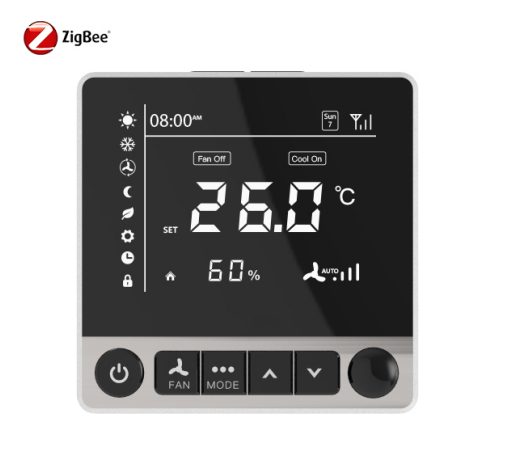
Xiamen, Fujian Oct 22, 2026 (Issuewire.com) - As smart buildings evolve toward more connected and energy-conscious operations, reliable room-level HVAC control has become an important part of building automation. As a High-quality zigbee fan coil thermostat manufacturer, OWON Technology develops intelligent thermostat solutions that combine wireless connectivity, environmental monitoring, and flexible temperature regulation. Its PCT504-Z ZigBee fan coil thermostat addresses the needs of residential and commercial environments by connecting everyday climate control with broader smart building systems.
Advancing HVAC Control Through ZigBee Technology
Heating, ventilation, and air conditioning systems directly influence indoor comfort and building energy consumption. Traditional thermostats provide basic temperature adjustment, but connected controls can support more flexible operation by linking room conditions with automation platforms and remote management tools.
OWON Technology addresses this transition through thermostat solutions designed for integration into connected environments. ZigBee wireless communication allows compatible devices to exchange information through an appropriate gateway, helping system integrators incorporate HVAC controls into wider smart home or building automation applications.
This approach can be useful in both new construction and renovation projects. Wireless connectivity can reduce reliance on additional communication cabling, although installation requirements still depend on the existing HVAC wiring, electrical supply, and selected automation architecture.
For property developers, facility operators, and smart building solution providers, the value of a connected thermostat extends beyond convenient temperature adjustment. It lies in the ability to coordinate room-level control with scheduling, occupancy information, and other building management functions.
PCT504-Z Combines Temperature Regulation with Smart Connectivity
OWON's PCT504-Z ZigBee fan coil thermostat is designed for applications that require configurable HVAC operation and integration with compatible smart systems. Its functions address several practical requirements of modern indoor climate management.
Flexible Fan Coil System Control
The PCT504 series supports two-pipe and four-pipe fan coil configurations, accommodating different heating and cooling arrangements. Available operating functions include heating, cooling, ventilation, and off modes, together with automatic and selectable fan-speed control.
These capabilities allow users or connected automation systems to adjust indoor conditions according to room requirements. In buildings with different room layouts or occupancy schedules, configurable control can help create more suitable operating conditions across individual spaces.
Compatibility remains an important consideration during product selection. HVAC equipment, wiring arrangements, electrical specifications, and model configurations must be checked to ensure that the thermostat matches the intended installation.
Remote Access and System Integration
ZigBee connectivity enables the PCT504-Z to communicate with compatible gateways and supported automation platforms. Its documented compatibility with ZigBee2MQTT environments also provides integration possibilities for applications using supported devices and software configurations.
Remote control can simplify everyday temperature adjustments, particularly in properties where users or operators need to manage rooms without accessing each wall-mounted thermostat. When connected to a suitable automation system, the device can become part of a broader control strategy involving multiple rooms or connected equipment.
However, ZigBee connectivity alone does not guarantee compatibility with every smart home platform or building management system. Successful integration depends on gateway support, device configuration, software interfaces, and the functions available through the selected system.
Environmental Monitoring and Occupancy Awareness
The PCT504-Z incorporates humidity display and passive infrared occupancy detection alongside its temperature control functions. These features provide additional information that can support more responsive indoor climate management.
For example, an automation system may use occupancy information to adjust HVAC operation when a room is vacant, provided that the relevant control rules and equipment support this behavior. Programmable schedules and Eco mode can further help align operation with expected room usage.
The effectiveness of these strategies depends on factors such as building conditions, HVAC efficiency, occupancy patterns, and configuration. Connected controls provide tools for managing energy use, but they do not independently guarantee a specific level of energy savings.
Applications in Residential and Commercial Buildings
The combination of wireless communication and configurable fan coil control makes OWON's thermostat technology relevant to a range of smart building applications.
In hotels and serviced apartments, room-level temperature adjustment can support guest comfort while giving operators options for coordinated control. When integrated with compatible occupancy or property management systems, thermostats may also contribute to automated room settings.
In office buildings, changing occupancy throughout the working day creates a need for adaptable HVAC schedules. Connected thermostats can support individual room adjustments and coordinated operation across offices, meeting rooms, and shared spaces when the wider system provides the necessary integration.
In residential developments, ZigBee-based controls can form part of a connected home environment. Remote access, programmable operation, and compatibility with supported automation platforms provide options for managing indoor comfort alongside other smart devices.
These scenarios illustrate potential uses based on the product's functions rather than claims about specific customer installations. Project suitability should be established through technical evaluation and compatibility testing.
OWON Technology's Product Development and Customization Capabilities
Smart building projects often require more than an individual hardware product. Device performance, firmware behavior, communication interfaces, and integration with existing software all influence the reliability of a complete solution.
OWON Technology, part of the LILLIPUT Group, has experience in electronic product development and IoT manufacturing. Its product portfolio includes smart thermostats, ZigBee devices, and energy management products, serving business customers involved in connected homes, property management, utilities, telecommunications, and system integration.
The company also provides original design manufacturing (ODM) services covering industrial design, hardware development, firmware and software engineering, and system integration. These capabilities allow business partners to explore product configurations and functionality suited to specific project requirements.
For HVAC brands and building automation providers, customization may be important when standard products do not fully match the intended application. Depending on the project, development work can involve hardware adjustments, software customization, application development, or integration with a customer's existing platform.
OWON's API and system integration services provide additional options for connecting supported devices with external applications and cloud environments. The feasibility of a particular integration depends on available interfaces, platform requirements, and the technical scope of the project.
This combination of product manufacturing and engineering support is relevant to B2B customers developing connected HVAC products or complete smart building solutions. Rather than treating the thermostat as an isolated device, the approach considers how hardware, software, and communication technologies work together within a deployed system.
Responding to Smart Building Industry Trends
The smart building industry is moving toward greater interoperability, more adaptable automation, and improved visibility into building operations. HVAC controls are an important part of this development because temperature regulation can be coordinated with occupancy information, operating schedules, and energy monitoring.
Wireless technologies such as ZigBee provide one approach to connecting devices, while gateways and software platforms help link device-level functions with broader management systems. For manufacturers, maintaining compatibility and supporting integration are therefore important alongside the development of individual product features.
Energy management is another continuing priority. Programmable thermostats and occupancy-aware strategies can help align HVAC operation with actual room usage, while connected controls offer greater flexibility when operating requirements change. Effective results still depend on system design, correct installation, and appropriate operating settings.
OWON Technology's combination of ZigBee thermostat products, IoT engineering, and ODM services addresses these requirements. Its work in connected devices provides a foundation for projects that need both room-level climate control and integration with wider automation systems.
Connecting Thermostat Technology with Building Automation
OWON Technology brings together wireless HVAC control, environmental monitoring, and customized IoT development to support connected residential and commercial environments. The PCT504-Z demonstrates how fan coil thermostats can contribute to a broader smart building strategy through configurable operation, remote access, and integration with compatible platforms.
As building automation continues to develop, practical system compatibility, reliable engineering, and adaptable product design will remain important considerations for integrators and property operators. Businesses seeking further details about OWON's thermostat range, product specifications, and development services can visit its official website: https://www.owon-smart.com/.
Source :OWON Technology
This article was originally published by IssueWire. Read the original article here.
More News

Presidential office denies investigation chief's Cabinet meeting attendance compromises impartiality
The presidential office on Thursday refuted media criticism that the chief of the new investigative body attending Cabinet meetings could compromise impartiality and independence in investigations. The response came amid growing media criticism after Kim Ji-yong, chief of the Serious Crime Investigation Agency (SCIA), attended Tuesday's Cabinet meeting for the first time since taking office, despite the long-held practice of investigation chiefs not attending such meetings. In a social media post the previous day, President Lee Jae Myung said chiefs of all government institutions under his command could attend Cabinet meetings, but many media outlets pointed out that such a move could compromise the investigation chief's independence and impartiality in conducting investigations. "The government is strenuously working toward maintaining fairness and political neutrality in investigations and independence in indictments. This principle will remain unwavering going forward," Lee's senior secretary for the press, Seong Ghi-hong, told reporters. The official also made clear that no individua

Soongsil University, Chung-Ang University team develops technology to disrupt lip-sync deepfakes
A joint research team from Soongsil University and Chung-Ang University has developed a technology to disrupt lip synchronization in deepfake videos that use artificial intelligence (AI) to make a person's lip movements match an audio track. Soongsil University said Tuesday that the team, led by professor Choi Dae-sun of its AI Security Center and professor Kwon Jun-seok of Chung-Ang University, developed the technology, dubbed MUTE. According to the team, MUTE is the first technology to disrupt lip synchronization in deepfake videos using audio protection alone. The paper, titled “MUTE: Multi-Level Alignment Uncoupling Against Talking-Head Exploitation for Voice Protection,” was accepted for presentation at the Conference on Neural Information Processing Systems (NeurIPS) 2026, one of the world’s leading AI conferences. The study was conducted as part of a research and development project supported by the Personal Information Protection Commission and the Korea Internet & Security Agency (KISA). The research team included doctoral student Kim Dong-hyun, master’s student Kim Seung

Seoul claims top spot in global AI adoption, 3rd overall in 2026 AI Cities Index
Seoul has secured third place overall — and claimed the top spot worldwide in artificial intelligence (AI) adoption and implementation — in the newly released 2026 AI Cities Index compiled by Britain’s The Observer, the Seoul Metropolitan Government said Thursday. The benchmark evaluation, built on Tortoise Media’s established Global AI Index, assessed 57 major metropolitan centers across 36 countries using 50 indicators split into three core pillars: investment, innovation and implementation. San Francisco and New York claimed the top two global spots, while Seoul finished third, outranking major international hubs including Beijing, Paris and London, which filled out the fourth through sixth positions. The Observer, founded in 1791 as the world’s oldest Sunday newspaper, introduced city-level rankings for the first time this year, capturing a fundamental shift as AI power increasingly concentrates in urban centers. Seoul’s standout performance came in the implementation category, where it ranked first globally ahead of Tokyo (third) and Singapore (fifth). This metric measu

Hankuk University of Foreign Studies offers training for new hires at semiconductor companies
Hankuk University of Foreign Studies (HUFS) held a two-day training program Oct. 19-20 to help newly hired employees at local semiconductor materials, parts and equipment companies develop practical skills. The university said Wednesday that its G-Anchor Project Group organized the program in cooperation with Yongin City, Gyeonggi Province. The G-Anchor Project is a provincial initiative designed to support universities in promoting regional innovation. Twenty-five newly hired employees from six semiconductor-related companies in Yongin — including Rorze Systems, BMI Tech, GnG InTech, SurplusGlobal, Justem and Appletree — participated in the training. They worked in a range of fields, including manufacturing, design, sales, research and development, and quality control. The training program aimed to deepen participants’ understanding of the semiconductor industry and develop the practical skills and workplace adaptability needed to perform their jobs effectively. Lim Ju-won, a professor in HUFS’ Division of Semiconductor and Electronics Engineering, oversaw the program. Faculty me

Incheon stabbing suspect tests negative for psychopathy
INCHEON — The suspect behind last week's stabbing spree in Incheon has tested negative for psychopathy, police and legal sources said Thursday. The Incheon Metropolitan Police Agency conducted a psychopathy test on the 59-year-old suspect, Choi Choong-rak, but his score fell below the 25 out of 40 points needed to classify him as a psychopath. Choi is accused of attempting to kill 10 people at a commercial complex in Incheon, west of Seoul, on Oct. 13, by wielding knives in both hands. The rampage left eight people injured, including one who remains unconscious after suffering cardiac arrest. The two others escaped without harm. During police questioning, Choi said he carried out the attack out of anger over medical treatment he received at a local hospital. He also told police that he did not target specific people but chose those who looked weaker than him. Choi has 10 prior convictions, including two for attempted murder. Police said they are analyzing evidence and conducting further investigations to determine his motive and whether the attack was premeditated.

Court rules against Lone Star in $125.9 mil. tax case
An appeals court on Thursday ruled against U.S. private equity firm Lone Star Funds in its suit against the Korean and Seoul city governments to return a combined 168.2 billion won ($125.9 million) in taxes. The Seoul High Court handed down the ruling against Lone Star after the Supreme Court returned the case to the appeals court for review in April last year. The Texas-based firm had earlier filed the suit against the state and the municipality, seeking the return of withheld taxes in connection with profits from its investments in Korea. Lone Star and affiliate firms purchased large shares of Korea Exchange Bank, Kukdong Engineering Construction and Starlease between 2002 and 2005, and made huge profits by selling some of the shares in 2007. They paid smaller taxes than local companies would have, citing the tax treaty that Korea has with Belgium where the company that made the investment was based. The National Tax Service (NTS) levied additional corporate taxes against Lone Star and its entities, offsetting them with withheld taxes. Lone Star then filed a suit seeking cancellation of

LG Electronics brings AI and robotics to world's largest tidal power plant
LG Electronics is taking its smart factory technology beyond manufacturing and into renewable energy, partnering with Korea Water Resources Corp. to develop artificial intelligence systems for one of the country’s largest power facilities. The companies signed a memorandum of understanding Thursday at Sihwa Lake Tidal Power Plant’s cultural center in Ansan, Gyeonggi Province, to explore AI-driven operations at the facility, which has the world’s largest installed capacity among tidal power plants. The partnership will combine K-water’s power plant operating experience and data with LG Electronics’ expertise in smart factories, digital twins, robotics and AI, the companies said. Under the agreement, they will examine a digital twin-based integrated operating system that creates a virtual model of the plant and incorporates real-time information from generating equipment and surveillance cameras. The system could help forecast electricity output, simulate operating scenarios and diagnose equipment conditions, enabling operators to identify problems and assess performance before m

Orion expands Custard cream cake production in Korea, Vietnam, India as global demand surges
Orion has expanded production lines for its flagship Custard cream cakes across Korea, Vietnam and India to keep pace with surging domestic and international demand, the company said Thursday. Launched in Korea in 2004, Orion Custard is a soft, individually wrapped sponge cake with a custard cream filling. It has become the company’s second-biggest global pie brand after its flagship Choco Pie. Global sales rose 14 percent last year to 154 billion won ($116 million). China, Vietnam and India accounted for 76 percent of that total, and sales kept growing at a double-digit pace through September this year. The company added a production line in Korea in September and recently began running new lines in Vietnam and India. The expansion lifts Custard’s global production capacity to as much as 300 billion won a year, roughly double last year’s sales. Orion’s global research center at its headquarters in Korea oversees product development for each market. In Vietnam, the company sells flavors including tiramisu, raspberry, egg lava, melon and a reduced-sugar version. There is also a fl

Young Poong loses shareholder derivative suit against Korea Zinc
A court on Thursday ruled against Young Poong Corp. in a shareholder derivative lawsuit seeking 837 billion won ($631 million) in damages from Korea Zinc Co. Chairman Choi Yun-beom and other company directors. Young Poong — a major shareholder in Korea Zinc — had filed the suit in November 2024, claiming Korea Zinc's directors had inflicted losses of 837 billion won on the company by making a tender offer involving the purchase of its own shares at 890,000 won apiece, when the actual price was around 560,000 won. The Seoul Central District Court ruled, however, that Korea Zinc's directors could not be deemed to have violated their managerial duties, given the steps they took before making the purchase. It also ruled that the action did not violate the Commercial Act or the company's articles of incorporation.

Ex-officials defend 2019 repatriation of NK fishermen as criminal deportation
Three former officials convicted of forcibly repatriating North Korean fishermen in 2019 defended the move Thursday, describing it as a deportation of criminals. Chung Eui-yong, former national security adviser, Suh Hoon, former National Intelligence Service director, and Kim Yeon-chul, former unification minister, made the assertion in a statement issued a day after the Seoul High Court sentenced them to suspended prison terms for their involvement in the case. "The reality of this case is not a simple forced repatriation of North Korean defectors," the statement said. "It was a deportation measure against criminals who fled to the South after committing serious inhumane crimes." The three served in former President Moon Jae-in's administration in November 2019, when Seoul deported two North Korean fishermen back to North Korea after they were captured near the eastern maritime border. The fishermen had been accused of killing 16 crew members. The move sparked outcry from critics as the fishermen had expressed their intent to defect to South Korea, which maintains a policy of accepting

Coupang, affiliates found to have committed 205 workplace safety violations
The government said Thursday it will take criminal enforcement action over safety violations at Coupang and its affiliates, after inspections uncovered suspected cover-ups of workplace accidents and inadequate safeguards at logistics facilities. The Ministry of Employment and Labor found 205 violations of the Occupational Safety and Health Act across 105 logistics centers and delivery camps. It said 61 violations would be subject to criminal enforcement action, while the remaining 144 would draw administrative fines totaling about 1.96 billion won ($1.48 million). Separate labor inspections also found that Coupang had failed to include key provisions of its performance improvement program (PIP) in its employment rules, in violation of the Labor Standards Act. The ministry said it will issue a corrective order and impose a fine. “Covering up workplace accidents or failing to report them not only prevents workers from receiving proper treatment and compensation, but also hinders efforts to determine their causes and identify and address hazards, making further accidents more likely,”

Nvidia broadens ties with Korean component makers
Nvidia is expanding partnerships with domestic component makers LG Innotek and Samsung Electro-Mechanics, strengthening its supply chain for physical artificial intelligence (AI) applications and next-generation AI infrastructure. LG Innotek unveiled a lineup of sensing solutions incorporating Nvidia's latest Holoscan Sensor Bridge (HSB) technology at the U.S. chipmaker's annual GPU Technology Conference (GTC) in Berlin on Tuesday (local time). The solutions include 3-megapixel camera modules and a multimodal vision system that combines multiple cameras and sensors, targeting applications in physical AI and robotics. Nvidia's HSB technology allows sensor data to be sent directly to AI computers, bypassing the central processing unit and potentially speeding up how robots and autonomous vehicles process information and make decisions. The partnership reflects growing demand for advanced sensing technologies as AI expands beyond software and data centers into physical environments, where machines must perceive and respond to their surroundings in real time. LG Innotek said it plans to expan
YOUR NEWS, OUR NETWORK.
Do you have Great News you want to tell the world?
Be it updates about your business or your community, you can make sure that it’s heard by submitting your story to our network reaching hundreds of news sites across 6 verticals.